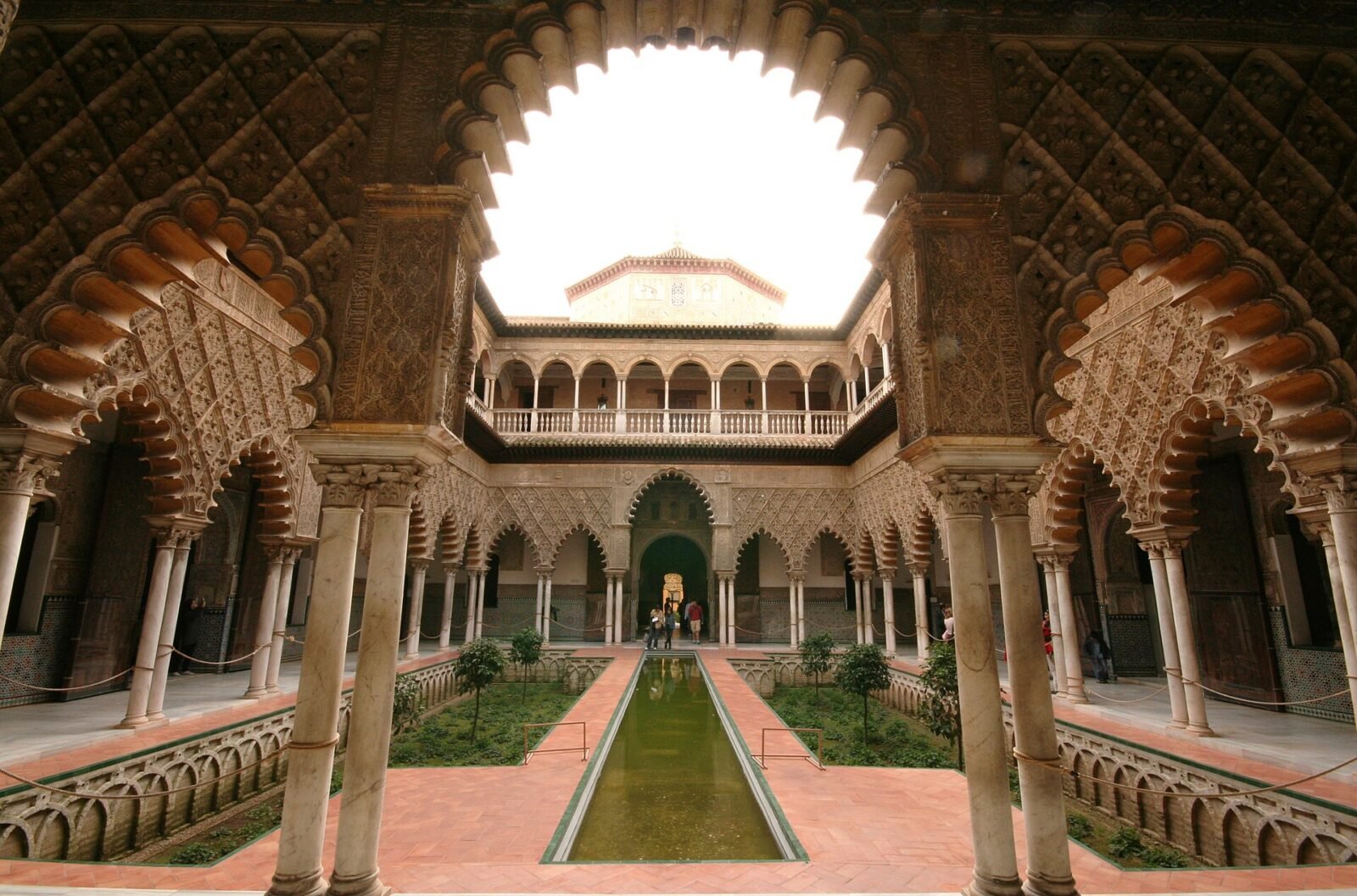
Seville offers far more than a collection of famous monuments. Spain’s Andalusian capital is a city of grand palaces, lively markets, centuries-old neighbourhoods, peaceful gardens and cultural traditions that remain part of everyday life.
You can spend a morning admiring intricate palace architecture, explore a neighbourhood shaped by generations of ceramic makers, watch a flamenco performance or simply walk beside the Guadalquivir as the city changes colour in the evening.
Whether you’re visiting for a weekend or staying longer, these 25 experiences will help you discover different sides of Seville. All are within the municipality, and each includes practical advice and a Google Maps link to make planning easier. You won’t need to do everything: choose a few experiences that interest you and leave time for the discoveries between them.
01 · ROYAL PALACE
Explore the Royal Alcázar and Its Gardens

The Royal Alcázar is one of Seville’s most impressive historic buildings, but its appeal goes beyond elaborate palace rooms. Centuries of architectural development are visible throughout the complex, from intricate Mudéjar decoration and richly coloured tiles to elegant gardens and fountains.
Give yourself time to explore the Patio de las Doncellas, the Salón de Embajadores and the garden paths. The contrast between highly decorated interiors and open green spaces is part of what makes the visit special.
Practical tip: Book admission through the official Alcázar website. Reservations are particularly sensible during busy periods. Allow several hours if you want to enjoy both the palace and gardens without rushing.
02 · ICONIC LANDMARK
Climb La Giralda and Discover Seville Cathedral

Seville Cathedral is an extraordinary example of Gothic architecture. Its enormous interior contains elaborate chapels, an impressive main altarpiece and the tomb of Christopher Columbus.
Beside the cathedral stands La Giralda, originally built as the minaret of the city’s great mosque and later adapted as a bell tower. Visitors who make the ascent can enjoy elevated views across the rooftops and streets of central Seville.
Practical tip: The Giralda ascent uses a series of ramps followed by steps and is not wheelchair accessible. If climbing is difficult for you, the cathedral itself still offers a rewarding visit. Check current tickets and accessibility arrangements through the official cathedral website.
03 · ARCHITECTURE & PHOTOGRAPHY
Walk Around Plaza de España

Created for the 1929 Ibero-American Exposition, Plaza de España is an enormous semicircular architectural ensemble surrounded by decorative bridges, a canal, elegant arcades and colourful ceramic tilework.
One of its most interesting features is the collection of tiled alcoves dedicated to Spanish provinces. Take time to examine several of them rather than only photographing the entire square. The details reveal an enormous variety of illustrations and decorative patterns.
Practical tip: Early morning is a good choice for visitors who want more comfortable temperatures and a calmer atmosphere. General access to the public square is free, although events can temporarily change access arrangements. Boat rentals may be available on the canal.
04 · HISTORIC NEIGHBOURHOOD
Get Lost in the Streets of Santa Cruz

Santa Cruz is one of the most enjoyable parts of Seville to explore without a strict route. Its narrow streets connect whitewashed houses, secluded squares, ceramic decorations and historic buildings.
The area formed part of Seville’s medieval Jewish quarter. Today, places such as Plaza de Doña Elvira, Plaza de Santa Cruz and Callejón del Agua offer opportunities to discover the neighbourhood’s distinctive layout and atmosphere.
Practical tip: Wear comfortable shoes because some streets have uneven paving. Santa Cruz is also a residential neighbourhood, so respect private courtyards and entrances. It’s easy to combine a walk here with the cathedral or Royal Alcázar.
05 · LOCAL CRAFTS
Discover Triana’s Famous Ceramic Tradition

Across the Guadalquivir, Triana has a long history of pottery and tilemaking. Its ceramics are an important part of Seville’s visual identity, appearing on buildings, monuments and decorative surfaces throughout the city.
Visit Centro Cerámica Triana to learn about traditional production methods and see the remains of historic pottery kilns. Afterwards, explore the surrounding streets and look for independent ceramics shops where you can discover different patterns and techniques.
Practical tip: If you want to buy locally made ceramics, ask where the pieces were produced rather than assuming every souvenir is manufactured in Triana. Check the museum’s current visiting arrangements before going.
06 · FOOD & MARKETS
Explore the Mercado de Triana
.jpg?width=1100)
Mercado de Triana is an excellent place to discover the ingredients and products that form part of Andalusian cooking. Its stalls traditionally offer produce, fish, meat, cheeses and other foods, while places to eat provide an opportunity to stop for a meal.
The market stands on the former site of Castillo de San Jorge, associated with the history of the Spanish Inquisition. This gives the location an additional historical dimension beyond its present-day role as a food market.
Practical tip: Visit during morning trading hours if you’re interested in the traditional food stalls. Restaurants and market stalls may operate on different schedules. Browse respectfully and avoid obstructing customers doing their everyday shopping.
07 · NATURE & RELAXATION
Take a Break in María Luisa Park
.jpg?width=1100)
María Luisa Park provides a welcome contrast to Seville’s busy historic centre. Its landscaped gardens contain fountains, monuments, shaded paths and decorative spaces associated with the city’s architectural heritage.
Rather than rushing through the park, choose a pleasant route and stop whenever something catches your attention. Plaza de América is particularly interesting for its surrounding exhibition-era buildings and ornamental design.
Practical tip: Entry to the public park is free. During warmer weather, bring drinking water and plan your walk around shaded areas. Some paths may be uneven or less convenient for visitors with mobility requirements.
08 · PANORAMIC VIEWS
See Seville from the Top of Las Setas

Las Setas, also known as Metropol Parasol, is one of the most recognisable modern structures in Seville. Its enormous wooden canopy rises above Plaza de la Encarnación, creating an architectural contrast with the surrounding historic streets.
The elevated walkway offers views across the city, making it especially appealing to visitors interested in photography and urban landscapes. The complex also includes a market and archaeological spaces, although these have separate visiting arrangements.
Practical tip: Consider visiting later in the day for changing light over the rooftops. Check current admission conditions and experiences at the official Las Setas website.
09 · MUSIC & PERFORMANCE
Experience a Live Flamenco Performance

Flamenco is one of Andalusia’s most important cultural expressions, bringing together singing, guitar and dance. A live performance can reveal its musical complexity and expressive range in a way that recordings cannot fully convey.
Seville offers various performance venues, but the Museo del Baile Flamenco is a useful starting point. Founded by dancer Cristina Hoyos, the museum combines exhibitions exploring the art form with live performances.
Practical tip: Reserve performances in advance during busy periods. Check whether your ticket includes the museum, the show or both. The official museum website provides information about available experiences.
10 · RIVERSIDE WALK
Walk Along the Guadalquivir and Visit Torre del Oro

The Guadalquivir has shaped Seville’s history through trade, navigation and the connections between different parts of the city. Walking beside the river provides a different perspective from the narrow streets of the old centre.
One of the most recognisable landmarks along the waterfront is Torre del Oro, a defensive tower dating from the Almohad period. Today it houses a naval museum and serves as an important reminder of Seville’s maritime history.
Practical tip: The riverside promenade is suitable for a relaxed walk, particularly when temperatures are comfortable. You can appreciate the tower from outside without buying admission. Check museum access separately if you wish to enter.
11 · WORLD HERITAGE & HISTORY
Discover the Archivo General de Indias

Located close to the cathedral, the Archivo General de Indias preserves historical documentation relating to Spain’s administration of its overseas territories. Its collections make it a significant institution for understanding the history of the Spanish Empire and the Americas.
The building itself was originally constructed as a merchants’ exchange and forms part of Seville’s UNESCO World Heritage ensemble alongside the cathedral and Royal Alcázar.
Practical tip: Visitor exhibitions and public access arrangements may vary. Check which areas are open before planning a visit. This is particularly worthwhile for travellers interested in history, archival collections and Renaissance architecture.
12 · ART MUSEUM
Admire Spanish Painting at the Museum of Fine Arts

Seville’s Museo de Bellas Artes is an essential stop for visitors interested in painting. Its collection is particularly strong in Spanish art and the Sevillian Baroque tradition, including works associated with Murillo and Zurbarán.
The building, a former convent, is also interesting in its own right. Galleries connect with courtyards and historic architectural spaces, providing a setting very different from a modern art museum.
Practical tip: Rather than rushing through every room, select a few artworks and take time to examine them. The museum offers accessibility facilities, and qualifying EU citizens can enter free with appropriate identification. Check the official museum information before visiting.
13 · HISTORIC ARCHITECTURE
Visit the Beautiful Casa de Pilatos

Casa de Pilatos is an outstanding example of an Andalusian palace house, combining Mudéjar decoration with Renaissance influences. Its architecture is especially interesting because different artistic traditions appear alongside one another.
Explore the central courtyard, admire the ceramic tilework and look for details in the ceilings, marble columns and surrounding rooms. The palace’s decorated spaces reward visitors who enjoy observing smaller architectural details.
Practical tip: Confirm which sections are included in your admission ticket, as access arrangements for different floors may vary. Visitors with mobility requirements should ask about accessible areas before purchasing.
14 · PALACE & GARDENS
Discover the Palacio de las Dueñas
.jpg?width=1100)
Palacio de las Dueñas offers an opportunity to explore the history of an aristocratic Seville residence. Associated with the House of Alba, the palace brings together courtyards, gardens, decorative art and rooms reflecting different periods.
The poet Antonio Machado was born here, adding another layer of cultural significance to the building. Visitors can appreciate the relationship between the architecture, collections and planted spaces.
Practical tip: Check ticket options and accessibility information through the official palace website. A visit works well for travellers who prefer historic houses and gardens to large, crowded monuments.
15 · BAROQUE ARCHITECTURE
Step Inside San Luis de los Franceses
._Sevilla.jpg?width=1100)
San Luis de los Franceses is one of Seville’s remarkable Baroque architectural treasures. Developed for the Jesuit novitiate, the church is associated with architect Leonardo de Figueroa and contains elaborate decorative work.
Its dome, fresco paintings and altarpieces create a richly ornamented interior. Visitors interested in architecture should take time to look upwards, as the ceilings and decorative programme are among the most striking elements.
Practical tip: The monument is located on Calle San Luis, making it a useful stop while exploring the Macarena area. Check current visiting times and any restrictions before travelling.
16 · HISTORY & LOCAL TRADITIONS
Explore the Macarena Basilica and Historic City Walls

La Macarena reveals a different side of Seville, where religious traditions, neighbourhood life and medieval remains sit close together. The Basilica de la Macarena houses the revered image of Nuestra Señora de la Esperanza Macarena, closely associated with Seville’s Holy Week celebrations.
Nearby, surviving sections of the old city walls and the historic Macarena Gate offer a glimpse into Seville’s former defensive system.
Practical tip: Treat the basilica as an active religious site and respect worshippers and services. The surrounding streets are worth exploring, especially if you want to see a quieter part of the city beyond its busiest tourist landmarks.
17 · SQUARES & SOCIAL LIFE
Spend an Evening at Alameda de Hércules
.jpg?width=1100)
Alameda de Hércules is a spacious public square with a distinctive character. Known for its monumental columns, cafés, bars and social atmosphere, it provides an alternative to the more monument-focused parts of central Seville.
The surrounding streets contain a mixture of traditional buildings, contemporary businesses and cultural venues. It is an interesting area for visitors who enjoy observing the everyday rhythm of a city.
Practical tip: Consider visiting in the evening, when restaurants and terraces bring activity to the square. Prices and experiences vary between establishments, so compare menus and choose somewhere that suits your preferences.
18 · TRADITIONAL MARKET
Explore Mercado de Feria and the Surrounding Streets

Mercado de Feria is a traditional neighbourhood food market where visitors can discover products and ingredients associated with local cooking. Its setting in the Macarena area makes it particularly useful for exploring streets outside Seville’s principal tourist circuit.
Calle Feria is also associated with El Jueves, a longstanding street market traditionally held on Thursdays, where traders offer antiques, second-hand items and various collectables.
Practical tip: Traditional food stalls generally operate earlier in the day. If El Jueves interests you, confirm that the market is taking place before travelling, particularly during holidays or exceptional events.
19 · CONTEMPORARY ART
Discover Contemporary Art at the Monasterio de la Cartuja

The Centro Andaluz de Arte Contemporáneo offers an unusual combination of contemporary art and historic architecture. The museum occupies part of the former Monasterio de Santa María de las Cuevas on the Isla de la Cartuja.
Its exhibition spaces explore modern and contemporary artistic practice, while the surrounding monastery buildings provide a contrasting historic setting. This makes it a particularly worthwhile experience for travellers interested in seeing something different from traditional palace museums.
Practical tip: Check current exhibitions and visitor arrangements through the official CAAC website. The Cartuja area is separated from the historic centre by the river, so plan your journey accordingly.
20 · FAMILY ENTERTAINMENT
Spend a Fun Day at Isla Mágica

Isla Mágica is a theme park located within Seville, offering an alternative to historical sightseeing. Its attractions and themed areas draw inspiration from the age of exploration, with rides and entertainment suitable for different ages and interests.
For families travelling with children, it can provide a welcome change after several days of monuments and museums. The park also has a separate water-focused area, Agua Mágica, with its own access arrangements.
Practical tip: The park operates seasonally, so check dates, opening times, attraction requirements and available tickets through the official Isla Mágica website. Do not assume Agua Mágica is included with every ticket.
21 · MARINE LIFE & FAMILIES
Discover Marine Life at the Seville Aquarium

The Acuario de Sevilla provides an indoor experience focused on aquatic environments and marine species. Its exhibitions introduce visitors to different ecosystems through tanks, displays and educational information.
It is particularly useful for families, although adults interested in marine life can also enjoy the exhibits. The attraction’s location near the Guadalquivir makes it possible to combine the visit with other activities in the southern part of the city.
Practical tip: Check current admission arrangements, activities and accessibility information through the official aquarium website. It can be a practical indoor option when outdoor temperatures are uncomfortable.
22 · ART & HISTORIC ARCHITECTURE
Visit the Hospital de los Venerables
_13.jpg?width=1100)
Hospital de los Venerables is a historic complex in Santa Cruz originally associated with the care of elderly priests. Today, it is known for its architecture and cultural activities connected with the Fundación Focus.
The building contains an attractive courtyard and a richly decorated church. Its relationship with Seville’s artistic heritage makes it a worthwhile stop for travellers interested in Baroque architecture and painting.
Practical tip: Visitor access and temporary exhibitions can vary. Check current opening arrangements and any available exhibitions before visiting, rather than assuming the entire complex is always accessible.
23 · GARDENS & QUIET WALKS
Enjoy the Peaceful Jardines de Murillo
.jpg?width=1100)
Jardines de Murillo is a pleasant green space bordering the historic Santa Cruz area. Although smaller than María Luisa Park, it offers a different kind of experience, with paths, planted areas and places to pause between sightseeing stops.
The gardens are named after the painter Bartolomé Esteban Murillo and form part of a historic urban landscape near the Alcázar. They provide an opportunity to enjoy some greenery without leaving the central tourist area.
Practical tip: This is a useful short stop rather than necessarily a destination requiring hours. Combine it with a walk through Santa Cruz or nearby historic streets. General public access is free.
24 · BAROQUE CHURCH
Discover the Iglesia del Salvador and Its Square

The Iglesia Colegial del Divino Salvador is an important Baroque church in central Seville. It stands on a site with a long religious history, where earlier Islamic structures preceded the present building.
Inside, visitors can discover elaborate altarpieces and decorative features typical of Andalusian Baroque architecture. Outside, Plaza del Salvador is a lively public square where the atmosphere contrasts with the quieter church interior.
Practical tip: Check current visiting arrangements because religious services can affect tourist access. The cathedral’s official ticketing information may include combined visiting options. Respect restrictions during worship.
25 · SCIENCE & EDUCATION
Explore the Casa de la Ciencia and Planetarium

Casa de la Ciencia offers a different experience from Seville’s historic attractions. The science museum occupies the former Peruvian Pavilion from the 1929 Ibero-American Exposition and is associated with Spain’s National Research Council, the CSIC.
Its exhibitions focus on scientific knowledge and natural subjects, while the planetarium introduces visitors to astronomy through educational presentations. This makes it particularly appealing to families and travellers who enjoy museums with an educational focus.
Practical tip: Planetarium sessions and exhibitions may have separate arrangements. Check the official Casa de la Ciencia website for current programming and opening dates before making plans.
Practical Tips for Enjoying Seville
Group nearby attractions. The Cathedral, Royal Alcázar, Santa Cruz and Archivo General de Indias are conveniently situated near one another. Triana’s market and ceramics centre are also easy to combine, while Plaza de España, María Luisa Park and Casa de la Ciencia form another useful group.
Plan around the weather. Seville can experience extremely hot summer conditions. If you’re visiting during warmer months, consider indoor activities during the hottest part of the day and save longer walks for more comfortable periods.
Reserve popular attractions. Major monuments and ticketed performances may have limited availability. Booking through official websites is generally preferable to relying on last-minute availability or unfamiliar third-party sellers.
Make time for food. Discovering Seville also means exploring its culinary traditions. Rather than planning every meal around a particular restaurant, leave opportunities to visit local markets, try traditional dishes and explore different neighbourhoods.
Check accessibility. Seville’s historic buildings and streets vary considerably in accessibility. Some attractions have lifts and adapted facilities, while towers, upper floors and uneven paving may present challenges. Confirm the specific areas you want to visit before purchasing tickets.
Don’t try to do everything. These 25 experiences are possibilities, not a single itinerary. A good visit balances major sights with ordinary city life. Some of the most rewarding moments may come from walking between attractions, finding a quiet square or discovering a neighbourhood you hadn’t originally planned to explore.