Moguer can seem familiar before you’ve been there. Its name appears in the story of Columbus’s Atlantic voyages and in the pages of Platero y yo, Juan Ramón Jiménez’s celebrated book. Yet the town deserves attention as a place in its own right. Within a walkable historic centre, brick and whitewashed walls frame a large church, a former fortress, religious foundations and a handsome civic square. Each tells a different part of Moguer’s story.
Allow half a day for an unhurried walk around the centre, or longer if you want to enter the museums and historic buildings. Unlike an itinerary that requires driving between scattered attractions, many of these stops can be approached on foot. The main variable is opening access: some monuments are working religious buildings or have visitor arrangements that differ from those of a conventional museum.
1. Begin at Plaza del Cabildo and the town hall
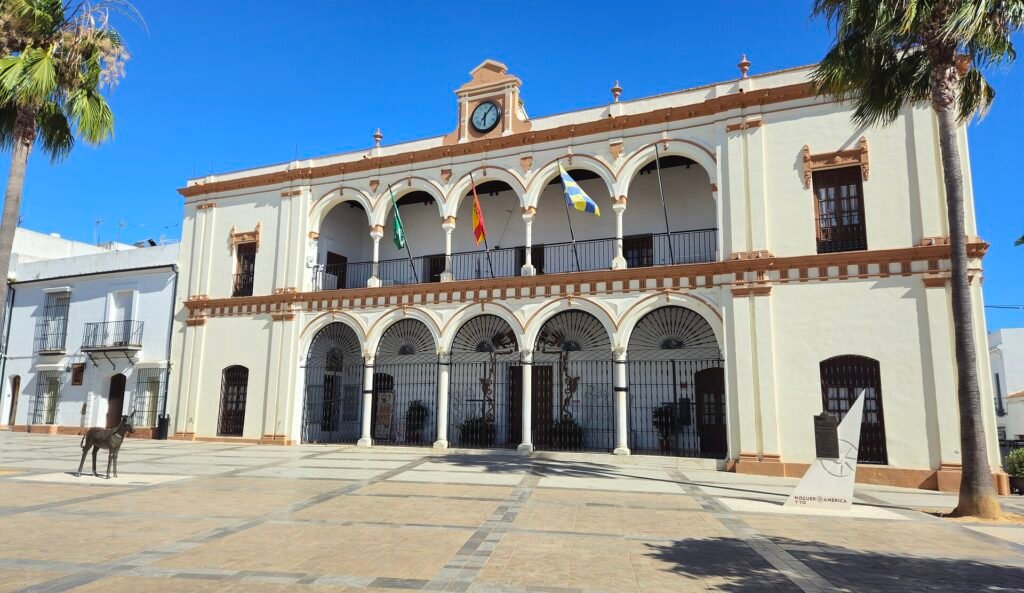
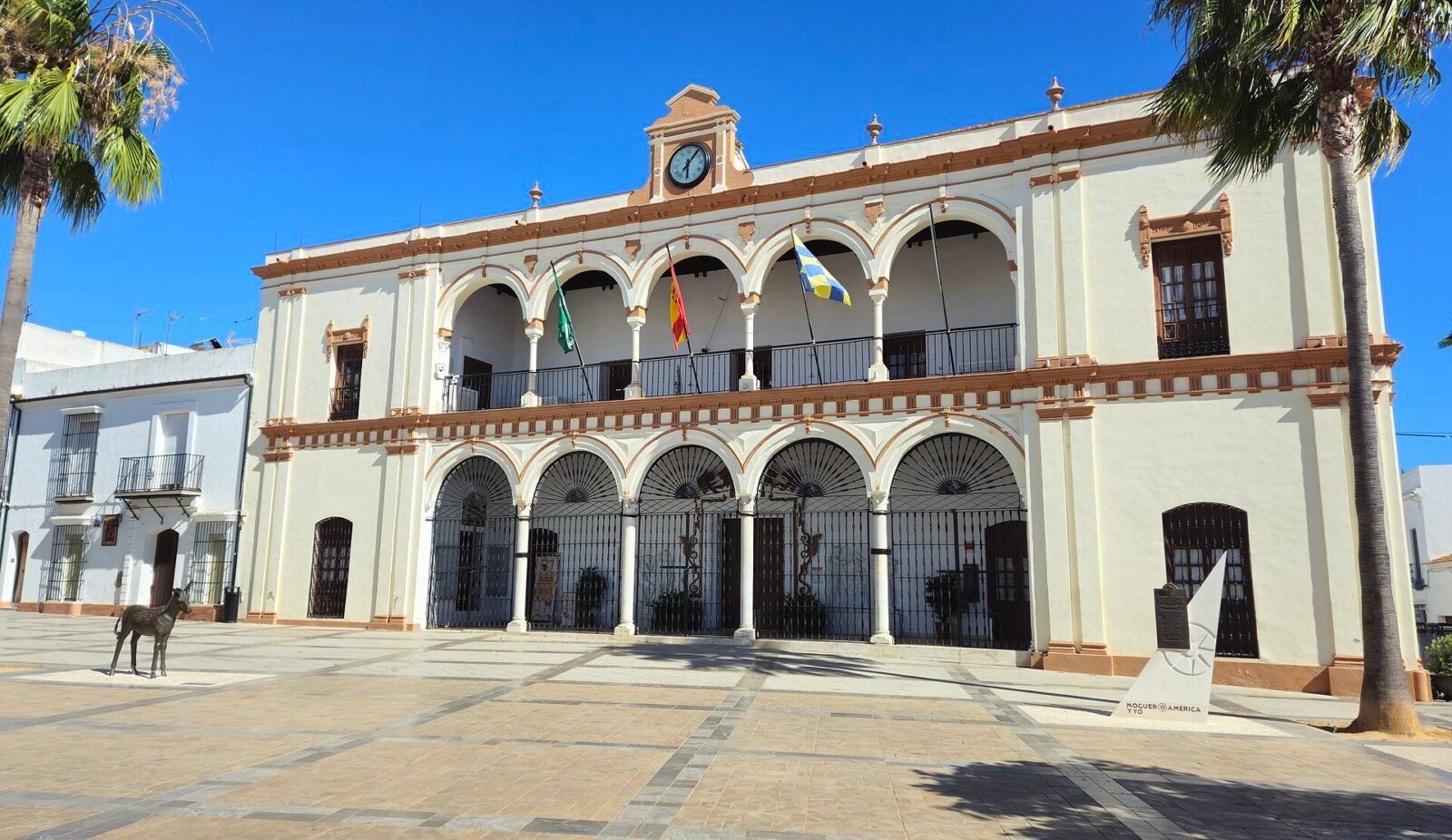
Start at Plaza del Cabildo, the civic heart of Moguer. The town hall is an attractive reminder that there is more to local architecture than churches and castles. Its façade has a balanced rhythm of arches, stone columns and details characteristic of the transition from Baroque to Neoclassical design. Look closely at the upper level and the relationship between the building and the square rather than treating it only as a meeting point.
This is also a convenient place to find your bearings. Nearby streets connect the civic centre to Moguer’s principal historic monuments, and the statue of Juan Ramón Jiménez introduces the literary thread you will encounter elsewhere.
Visiting advice: Enjoy the square and façade freely, but do not assume the town hall’s working offices or interior courtyard are open for tourist visits. The municipal tourism office can advise on guided routes and monument access.
2. Look inside the Iglesia de Nuestra Señora de la Granada
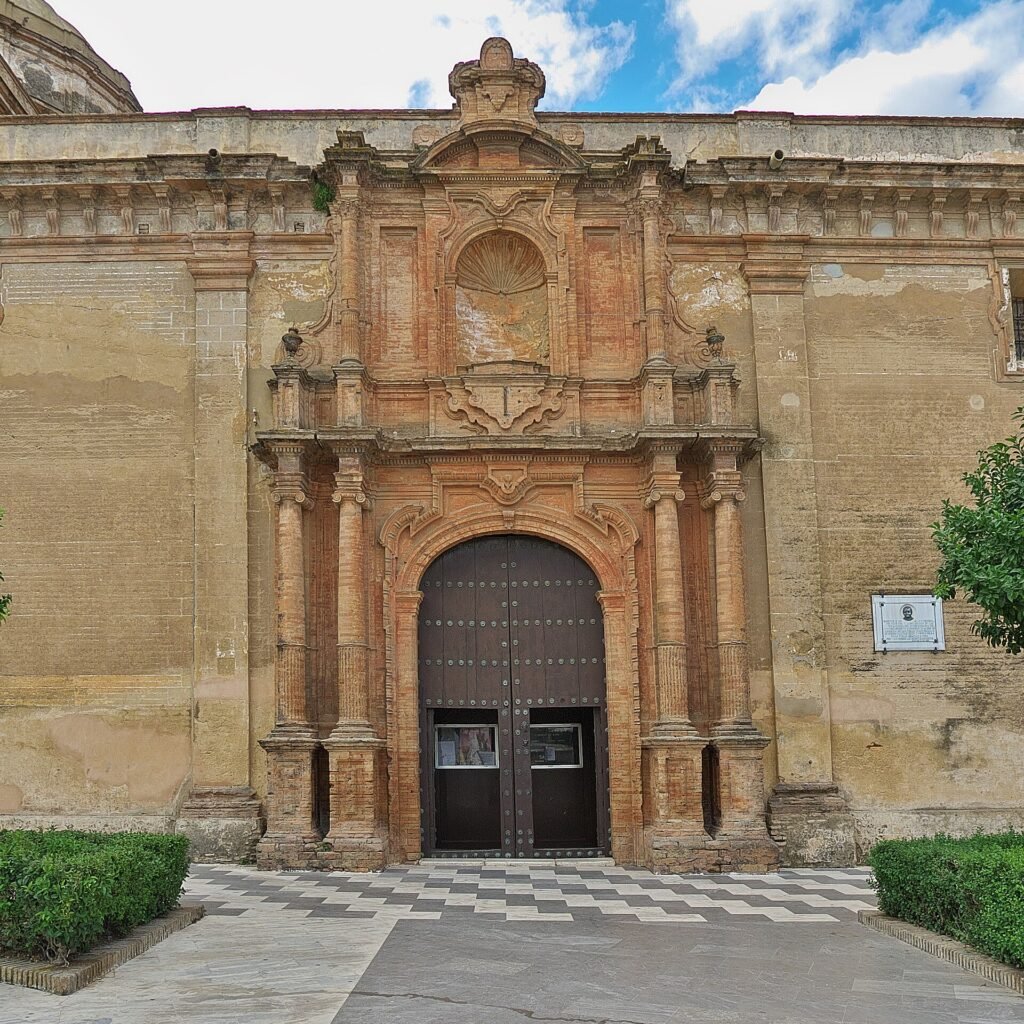
One of Moguer’s most distinctive buildings is the Iglesia de Nuestra Señora de la Granada. It is an unusually substantial parish church for a town of this size, with five naves and a tower that has long defined the skyline. The scale becomes more apparent when you approach from the surrounding streets: the church seems to occupy much of its own neighbourhood.
The building also speaks to the disruptions that shaped the region’s architecture. Earthquake damage and later rebuilding influenced the church’s appearance, so it is worth considering how different periods sit together rather than expecting a single, untouched medieval interior. Its ornate entrance is rewarding even when access inside is limited.
Visiting advice: This remains an active place of worship. Check for services, closures and possible restoration work; entry arrangements for a religious visit are not necessarily the same as for sightseeing.
3. Discover the remarkable Monasterio de Santa Clara
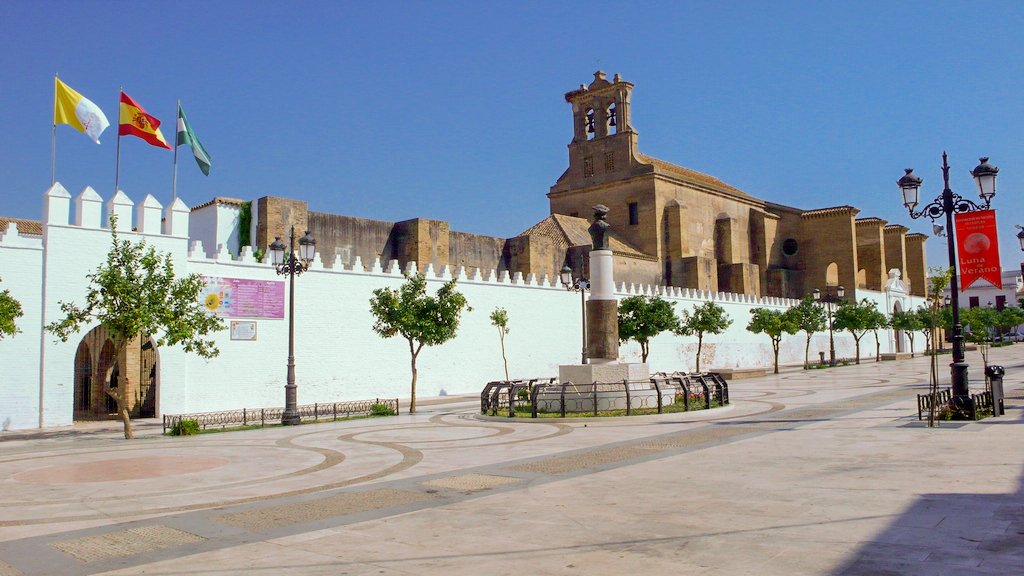
Santa Clara is a major reason to choose Moguer for a heritage day trip. Founded in the fourteenth century, the monastery preserves important Gothic-Mudéjar elements, including a historic church, cloister and remarkable choir furnishings. Instead of seeing it simply as another religious monument, pay attention to the building’s layers of use: prayer, community life, local aristocratic patronage and, eventually, its role within the Columbian heritage of the area.
The monastery is part of the region’s Lugares Colombinos, locations associated with voyages to the Americas. Its history is broader than that connection, however. Inside, the architectural spaces are especially valuable for understanding the influence religious institutions once held over the surrounding town.
Visiting advice: Santa Clara is not a place to assume is open for casual walk-in access every day. Ask the local tourism office about guided visits, which parts can be seen and any reservation requirement. The outside, by Plaza de las Monjas, is worth seeing regardless.
4. Seek out the remains of Moguer Castle
Not all the town’s medieval history survives in complete form. The Castillo de Moguer began as a defensive site and was transformed during later periods, including the Almohad and medieval Christian eras. What remains is more fragmentary than the dramatic hilltop fortresses found elsewhere in Andalusia, but that is precisely why it can be interesting.
Rather than expecting intact battlements and a museum route, look at the surviving fabric and imagine how the town once grew around a fortified centre. The municipality identifies an old cistern beneath the former parade ground as one of the historically significant surviving features. Parts of the complex have since been adapted to municipal functions.
Visiting advice: Do not count on access to the cistern or enclosed areas without checking. This is best approached as a heritage stop on a town walk, not as a guaranteed ticketed castle tour.
5. See the Convento de San Francisco
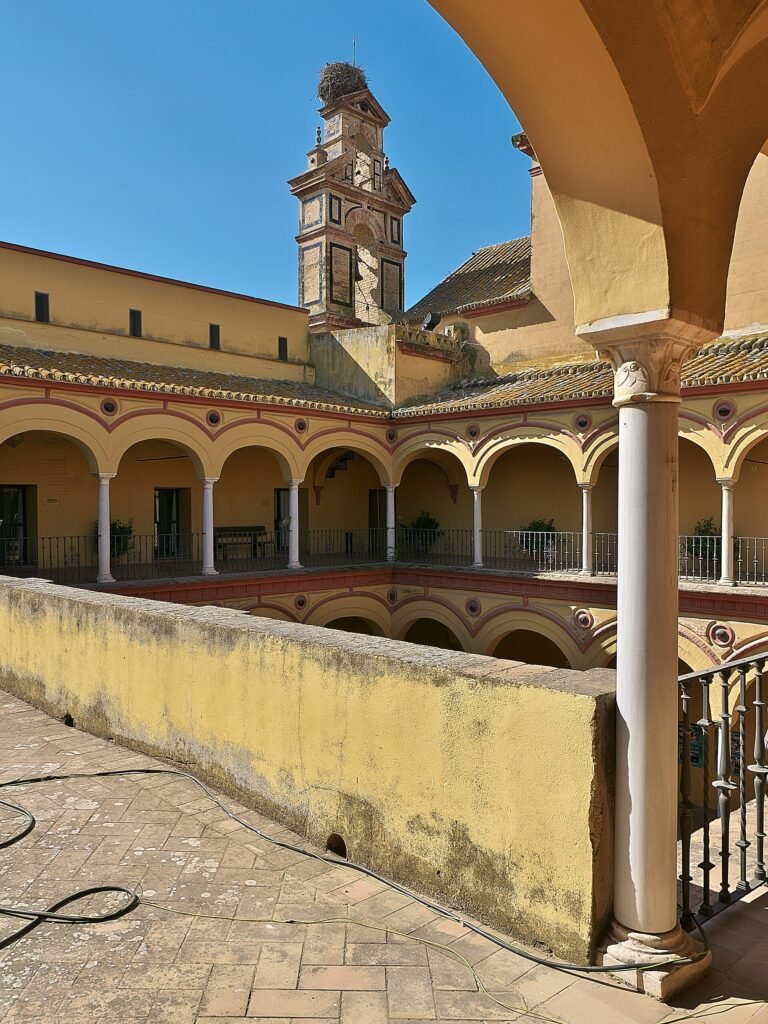
Convento de San Francisco adds another chapter to the town’s connection with the Atlantic world. Established in the late fifteenth century, it was rebuilt and altered over time; its church and cloister display a more restrained architectural language than the richly decorated spaces of Santa Clara. The complex also became an important centre of learning and religious activity.
Its former Franciscan community had connections with missions across the Atlantic. That background gives the cloister and church an added historical context, although today some parts of the building have civic uses, including archives and library functions.
Visiting advice: The building’s active institutional uses do not guarantee public access to every historic room. Check before expecting to see the cloister. Its exterior is straightforward to include in a central walking route.
6. Step into Moguer’s literary world at the Casa Museo
Juan Ramón Jiménez, awarded the Nobel Prize in Literature in 1956, grew up in Moguer. The Casa Museo Zenobia y Juan Ramón Jiménez is housed in the family’s later home, not the poet’s birthplace, and contains objects, books and materials associated with his life and with Zenobia Camprubí, an important translator and cultural figure in her own right.
This is the most rewarding indoor stop if you’ve read Platero y yo or want to understand why Moguer occupies such a central place in the poet’s writing. The museum’s displays are better approached as a history of two intertwined intellectual lives than as a shrine to one famous name.
Visiting advice: The museum’s visitor page gives current booking guidance. It advises calling ahead and notes that the building has a visitor lift. Leave time for the visit instead of inserting it between several rushed stops.
7. Find Platero in the streets
Moguer’s relationship with literature is visible even without entering a museum. The open-air Platero EScultura route places sculptures inspired by the book among everyday streets and squares. Instead of searching only for a single donkey statue, follow the idea behind the route: passages of literature have been placed back into the town that helped produce them.
A recent sculpture outside the Casa Museo represents Juan Ramón and Platero together. Elsewhere, the town uses plaques and sculptural works to connect particular places with the poet’s writings. It makes walking more rewarding, especially if you recognise an episode from the book.
Visiting advice: The exterior sculptures can be enjoyed without a museum ticket. Ask at the tourism office for an up-to-date route; individual pieces may be added or relocated over time.
8. Look for a performance at Teatro Felipe Godínez
History in Moguer is not confined to historic buildings. Teatro Felipe Godínez is a contemporary cultural venue dedicated to a Golden Age playwright from the town. Its programme can include theatre, music and other cultural events. The theatre also incorporates an older decorative façade, an interesting example of how the town has adapted earlier architectural fabric for a new function.
If your visit happens to coincide with a performance, it can provide an experience that feels more connected with present-day Moguer than another monument photograph.
Visiting advice: Check the municipality’s cultural programme; this is not an attraction with a permanent walk-through exhibition. The exterior is worth a brief look even when nothing is scheduled.
How to plan your visit
A practical route begins at Plaza del Cabildo, continues to the parish church and Santa Clara, then loops through the castle area and San Francisco. Finish with the Casa Museo if its opening time suits your day. This combines different periods of local history without requiring a car for each stop.
Moguer is also part of the wider Columbian heritage area in the Province of Huelva, but the sites at La Rábida and the replica ships are in Palos de la Frontera municipality, not Moguer. They can be a separate excursion rather than being mislabeled as attractions in the town.
- Time: Reserve several hours for the centre; a museum or guided monastery visit can extend it comfortably into a full day.
- Access: Historic surfaces, steps and uneven thresholds vary from building to building. Ask each venue about the parts that are accessible.
- Tickets: Check each institution separately. Do not assume that religious monuments have the same visitor policy as museums.
- Summer: Plan the longest outdoor walking segments when temperatures are more comfortable.
The pleasure of Moguer is in the changes of scale: a large religious building, a compact civic square, a fragment of fortification, then a street that appears in a writer’s memories. None of those experiences needs exaggerated claims to be worth your time.